Last night we stayed in and ate at the hotel because the weather was stormy. It is, after all, Winter here. The wind blew so hard it rattled the sliding glass door to the balcony, all night long. The winds are known as the prevailing westerlies, or North Wester. Every night so far, we have slept with that door open but tonight it was closed and the heat was on.
The Cape was often known as the "Cape of Storms" because of its vicious weather, which left Table Bay littered with wrecks. Throughout the first half of the nineteenth century, arguments raged in Cape Town over the need for a "proper dock". Many makeshift attempts were made to remedy the situation, including the construction of a lighthouse in 1823 and work was begun on a jetty in 1832. In the 1850's, with the increase in sea traffic coming to the Cape, the need for a harbour increased, reaching its peak in 1860, when Loyd's insurance company refused the risk of covering ships dropping anchor in Table Bay. The British colonial government dragged its heels due to the costs involved, but eventually conceded. The breakwater, the westernmost arm of the harbour, was completed with convict labour. In 1869, the dock (consisting of two main basins) was completed and the sea poured in!

All this with the magnificent back drop of Table Mountain. I can't stop photographing it. Each day it looks different to me. Some days completely covered by a blanket of clouds, sometimes just the top has a cloud cover (the table cloth) and days like today it is crystal clear. Each day I say I have enough pictures of the mountain and then, like a siren of the sea, it lures me into capturing it's beauty again. Thank goodness for digital photography! Here it is this morning:

Here is how it looked yesterday as the storm began to blow in.

Since today looked like it was going to be a beautiful day I decided to go to Green Market Square. I am sorry to report that so far my search for a Caftan has been unsuccessful. Fortunately, there is a lot of time left and I remain hopeful. I was told that the Green Market Square had a greater variety of goods and much better prices than the waterfront so I hurried on down there this morning. It is a large, open market with cobbled streets, coffee shops and grand buildings. As the name implies, it started as a vegetable market but now is more like a flea market. They sell crafts, jewellery and Congolese and Zimbabwean artifacts such as tribal masks and malachite carvings. I wasn't prepared for what I was about to face. Here are some pictures of the market just so you can get the feel for how it looks.


Let me say right off that I am no stranger to bargain hunting. I consider myself a good negotiator, for the most part. This place beat me down. From the first booth to the last, I was lost. I was told you could dicker so I was all set for that. What I wasn't prepared for was their insistence. The minute you ask "how much" it is like you have already agreed to buy and now it is just a matter of price. You better not ask if you don't want to buy it for any price. My plan was to walk from booth to booth, survey the prices and then at the end go back for the things I really liked and begin the bargaining there. 'Au contraire mon frere". The first booth had some table linens that were nice but the lady was a bloodhound. I asked about a table runner and she said 350 rand which would be $70.00. I said no thanks and she said "because you are my first customer 300 Rand". No thanks I said. "How much do you want to pay"? she said. Less than that I thought. It was at this point that I realized I didn't have much cash and for some crazy reason, I thought they would take credit cards. When I realized they didn't, I told her it was a mute point since I didn't have cash. "How much do you have"? I think that is rather a personal question but it didn't stop her. "You are like my mother, my family, my friend", she said. By this time she was down to 200Rand which is closer to $30.00 but still I didn't have any cash. She was relentless. She told me she would go to the bank with me and I could use my ATM card there. If I was going to do that, I was going to walk around the market and figure out everything I wanted to buy and do it all at once so that I would only pay one transaction fee. She didn't see that one coming (one point for Kiki) Now the price was 150Rand. The problem was that what she saw as a negotiating tactic was really the truth. I finally wrangled myself away from her (after losing any desire for her table linens) and came upon Monibah. (pronounced Mon-ee- bah, with the accent
on the E)
MONIBAH

Unlike the ladies of the waterfront market, Monibah was all business. She was unwilling to share much about herself. I did find out that she was 58 yrs old and had six children. Her husband was still alive and she was from Ghana. She was the only one who didn't pressure me so it made me want to buy something from her. She had the most beautiful cashmere scarves and was very honest about where they came from. She said they did not have cashmere in South Africa but they were made in Egypt. I just wanted to be sure they didn't come from China, as I think they already have enough of our money. She recommended I look around and come back if I liked hers the best. My idea, exactly!!! I told her how much pressure the others used and that I felt badly walking away. She said, "Ah yes, but then you have to feel sorry for everyone and you can't do that". How right she was. I think Monibah fancied herself a bit of a medicine woman. She stayed away from any conversation that was too personal until we got on the subject of herbs. She could tell that my back was hurting (from walking on the cobblestones) and she launched into her diatribe about herbs. She said she had given up all "tablets" and "powders" from the doctor and that the only thing she took was aloe and grapevine. She attested to its power to cure gout, arthritis, heart disease, diabetics, symptoms of menopause and most minor aches and pains. At one point, she got very graphic about the effect of these herbs on your bodily functions but I will spare you that conversation. All in all, she was quite sweet and if I had any cash I would have spent it with her. I finally developed a non committal attitude. It was the only way to survive. I kept my head down as I passed the booths and only peered out the corner of my eye at their goods. They all greet you and try to start up a conversation to get you to stop. I felt so rude just walking by when they are being so nice but if you stop you better want to buy something. My story about the ATM worked for most but some just didn't believe it and would keep asking how much money I had with me. I stopped by one booth to bend over in an effort to stretch my back and this sweet lady offered me her chair. I took it. That is where I met Lorette.
LORETTE (said with a rolling "r")

She was the younger sister of the lady who ran the booth. She was a little "Chatty Cathy" and loved talking about herself. She was 20 yrs old and was born in the Congo. Her Mom and Dad still lived there with her two brothers. Her mother is a teacher and is the only one at home who has a job. Her two brothers don't work because she says there is no work there. I asked her why she left and she said it was because there was nothing to do in the Congo. She loved living with her sister in South Africa but she didn't seem to have much direction. She came to the market several days a week to help out because her sister provided her food and clothes. She said she would like to get married one day and have some children but not anytime soon. She wanted to have fun and enjoy her life now. Not too different from most young women in the states. I think she really wanted to open up and keep talking but her older sister was more guarded and must have given her "the eye" because she would only talk when her sister was busy helping someone. She told me that she had one sister who lived in Texas and that one day she wanted to go there. She then took out a notebook that must have had 100 or more names and phone numbers of people in the states and asked me to write mine down. She said when she came to visit she would call me up and come see me. I wrote the information down but knew it would not happen. Not that she won't ever get to the states, she well may. It is that she has no concept of how large our country is and how far apart we all are. I didn't want to do anything to dispel her hopes and dreams so I agreed it would be a nice trip and would love to hear from her.
About that time I was tired and needed to sit for awhile so I left the square to get some lunch. I got a simple sandwich of meat,cheese and wheat bread and a bottle of water. The lady asked me if I wanted it toasted and I thought, sure, why not? I'll tell you why not, because it had lettuce and tomatoes on it. Warm, wilted lettuce and hot, soupy tomato all melted together with a sliced of cheese. I will just leave it by saying it was not the culinary treat I had hoped for. It served to fill the hole in my stomach and gave me the opportunity to meet Ilkay.
Ilkay (means "first moon")

After I placed my order inside, I went out to the sunny sidewalk surrounding the market and had a seat at one of the tables. In a few minutes, Ilkay delivered the "gourmet delight". She was from Turkey and really struggled with English. Unlike all my other encounters, it was not I, but she who initiated the conversation. As it turns out, she left Turkey to come to South Africa to study English. She said she loved it here and didn't want to return to Turkey. Now remember, her English was very rudimentary so we really had to work at our conversation. The main reason she liked it here was because the people were so nice. I certainly can attest to that. Ilkay's assesment of the people here were that they were happy and smiling and the people in Turkey were "angry". I think she used that word because her vocabulary was so limited. She described the South Africans as "relaxed". She made faces to represent each group. The South Africans with a big, cheery smile and the Turkish with a scowl. I asked why the Turks were angry and she said "because of their jobs, money, everything". I'm sure she wanted to express more but just didn't have the words. She is thirty years old and didn't want to get married or have children. When I asked why she said men and children were a "problem" and she liked being single. She did make an allowance for the fact that she might fall in love and if that happened she might change her mind but she thought most likely she would stay single. Both of her brothers have children and are divorced so that may have influenced her feelings about marriage and children. She had not been back to Turkey in three years. When I asked her if she missed her family she said that she talked to them every Sunday and that was enough. One day she might go back but not until her English was much better. (She's going to be here awhile.) Then in a very hushed tone, looking back over her shoulder at the place she worked, she confided that she didn't much like her job and she would quit if she could find something else she liked better. In her broken, pieced together English, she was able to communicate that it was more important to like your job than to make a lot of money. How can you argue with that? (Note to Hiro: she didn't use the "little words" either).
When I left the market I headed to the adjacent street to see the Old Town House.
It is a beautiful example of Cape Dutch architecture. It has been a guard house, a police station and Cape Towns City Hall.  Today it houses the Michaelis collection of minor but interesting seventeenth century Dutch and Flemish landscape paintings. The interior of the building has lots of gorgous wood on the floors, walls and ceiling,. I tried to photograph it but the light wasn't that good so you won't get to see the real beauty of it.
 Today it houses the Michaelis collection of minor but interesting seventeenth century Dutch and Flemish landscape paintings. The interior of the building has lots of gorgous wood on the floors, walls and ceiling,. I tried to photograph it but the light wasn't that good so you won't get to see the real beauty of it.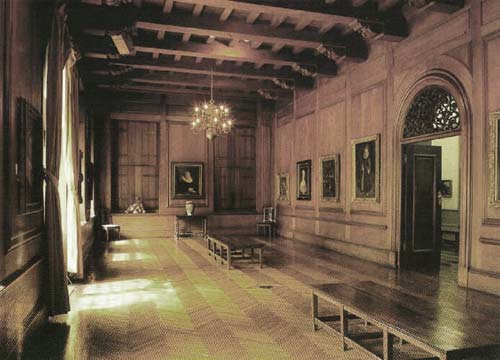
Here you can see most of the room but the next photo shows the richness and color of the wood.


The best thing I saw here was a picture for the blind. Why would a blind person go to an Art Museum, I wondered. But if they did, there would be at least one picture they could "see" here. It was on a pedestal and in braille, I guess. The description below it was for sure and the landscape itself was made of some kind of metal and had lots of texture (relief). Very thoughtful. 

Can you see the texture in the tree?

When I finished at the Museum, I headed to the taxi area to go home when I saw the nice young man who was selling tribal masks come running across the square. "Lady, Lady, he was calling". As a side note, all the men here refer to women they don't know as "Lady" which is the southern equivalent of Ma'am. It is always said with kindness and respect but still seems a bit odd to me. He explained that he had found a shopkeeper who would let me use my credit card (although he would charge the young man 10% for the transaction) so we headed back to his stand. There was a beautiful Mask by the Ndelebe tribe of South Africa that I had been interested in. I had read a lot about tribal masks before I came here because (along with the caftan that has eluded me so far) I knew I wanted a mask for our new home. You have to be careful because many of them are just cheap reproductions from the Phillipines or China. Those are shiny and all look like cookie cutter copies. The real masks are old, have been used, and are all one of a kind. Once you start looking at them you begin to be able to recognize the differences between a Zulu mask or a mask from the Congo etc. Each mask has a particular meaning or purpose. They have masks for marriage, furnerals, initiations, fertility (I almost bought one of those for Chris and Chrissy but thought better of it ;) and a host of other occasions and meanings. The one I liked was for happiness in the home and family. What could be better than that? After a little more haggeling and a walk up to his friends shop, the mask was ours. Nothing left now but to get it home and find its rightful place. Here is a picture of it: 

For dinner, we went next door to the sister hotel to ours named the Portswood. The Quarterdeck Restaurant is on the site that was once the Cape Colony petty-crimes prison and was declared a national monument and transformed into a restaurant in 1994. The Quarterdeck Restaurant occupies a section of the Original Breakwater Prison known as the Good Conduct Ward.

The specialty here offers a Cape Malay Potjiekos - literally meaning pot food - and has been part of South Africa’s culture for many centuries. Today, cooking up a potjie has evolved into a unique South African social happening, a tradition almost as popular as the legendary braai.

Another beautiful day in South Africa but I must hurry home and get some sleep because I'm sure that "Devil Mountain" will be calling me to take its picture again tomorrow!!
Love to you all!
Christine

No comments:
Post a Comment